THE LIGHTLESS LIGHTHOUSE: When Orthodoxy Loses Its Soul
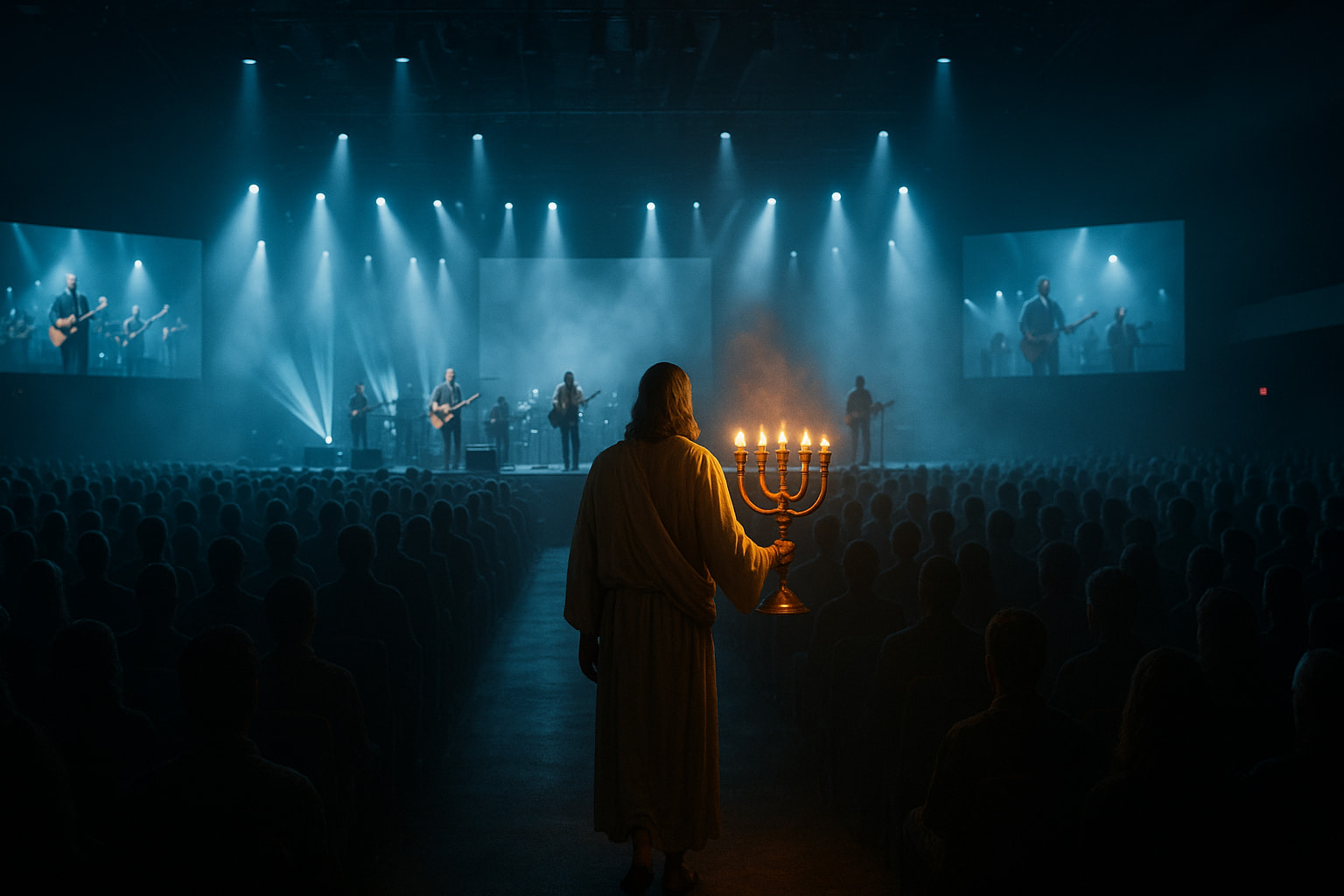
In the modern religious imagination, Jesus is often pictured as a gentle Shepherd on a distant hill or a King on a faraway throne. But the Book of Revelation opens with a significantly more unsettling image: Christ is the Auditor in the aisle.
“‘The words of him who holds the seven stars in his right hand, who walks among the seven golden lampstands…'” (Revelation 2:1, ESV)
The Greek word for “walks” (peripatountos) implies active, scrutinizing movement. He is patrolling. He is not merely inspecting the architecture of the building or the size of the budget; He is inspecting the quality of the light.
In His first review, He approaches the church in Ephesus. This is not a critique of a dying church. Ephesus was a theological powerhouse—a spiritual machine running at maximum efficiency. Yet, Christ’s diagnosis reveals a terrifying possibility: a church can have perfect hands and a dead heart.
I. THE PERFECT RESUME (THE TRAP OF EXCELLENCE)
If the church in Ephesus existed today, it would be the model for every church planting conference. They were the “Navy SEALs” of the early church—disciplined, discerning, and tirelessly active. Christ begins by validating their resume:
“‘I know your works, your toil and your patient endurance, and how you cannot bear with those who are evil, but have tested those who call themselves apostles and are not, and found them to be false. I know you are enduring patiently and bearing up for my name’s sake, and you have not grown weary.’” (Revelation 2:2–3, ESV)
Notice the intensity of the language. Christ uses the word kopos for “toil,” which refers to labor that leads to exhaustion. They are not lazy. They are doctrinally sharp; they “cannot bear” false teachers. They have strong structural integrity and high standards.
The Application Bridge
This text shatters the “Resume Defense.” Many of us evaluate our spiritual health by our activity log: I serve in the nursery, I tithe, I attend small group, and I hold to the inerrancy of Scripture. Ephesus did all of that, likely better than we do. You can possess the correct theology and the correct behavior, yet still be flagged by the Inspector. The Ephesian church proves that you can be busy for God while being distant from Him.
II. THE FATAL FLAW (ABANDONMENT, NOT LOSS)
Despite the glowing review of their operations, Christ identifies a catastrophic failure in their engine.
“‘But I have this against you, that you have abandoned the love you had at first.’” (Revelation 2:4, ESV)
We often soften this text by saying they “lost” their first love, as if it were misplaced car keys—an accident of forgetfulness. But the text uses the word aphekes, which means “to abandon,” “to let go,” or “to send away.”
This was a willing choice. Over time, the maintenance of the ministry began to eclipse the Master of the ministry. They shifted from being a Bride to being an employee. The “toil” (kopos) continued, but the motivating fuel changed. They were running on duty, habit, and pride rather than the burning oxygen of affection for Christ.
The prophet Jeremiah illustrated this tragedy centuries prior:
“‘…for my people have committed two evils: they have forsaken me, the fountain of living waters, and hewed out cisterns for themselves, broken cisterns that can hold no water.’” (Jeremiah 2:13, ESV)
Ephesus was busy hewing stone. They were building structures, defending truth, and carving out a reputation. But they had disconnected from the Fountain. They were a high-functioning machine, but they were dry.
III. THE CURE: THE “ACTS 19” PIVOT
The remedy Christ prescribes is precise:
“‘Remember therefore from where you have fallen; repent, and do the works you did at first.’” (Revelation 2:5a, ESV)
Modern readers often misinterpret “do the works you did at first” as a command to do more—more volunteering, more reading, more evangelizing. But if Ephesus was already “toiling” to the point of exhaustion (v. 3), surely the answer isn’t just to work harder?
To understand “First Works,” we must let Scripture interpret Scripture. We must look back at the origin story of the Ephesian church to see exactly what their “first works” were. The historian Luke records the specific behavior of the early Ephesian converts:
“Also many of those who were now believers came, confessing and divulging their practices. And a number of those who had practiced magic arts brought their books together and burned them in the sight of all. And they counted the value of them and found it came to fifty thousand pieces of silver.” (Acts 19:18–19, ESV)
This was their First Work. It wasn’t a bake sale; it was a bonfire.
It was a radical, costly, public act of abandonment. 50,000 drachmas represented a fortune—financial security and cultural power—and they incinerated it to possess Jesus.
The Application Bridge
The cure for a cold heart is not to add more religious maintenance to your schedule. The cure is to return to the radical nature of your conversion.
-
Then: They burned magic books.
-
Now: We must burn the modern equivalents—our obsessive need for approval, our reliance on a “safe” secular worldview, our hidden idols of comfort, and our syncretism that tries to mix Jesus with worldly philosophies.
To “do the first works” is to stop managing a religious facade and to once again take the dangerous risk of surrendering everything for the sake of knowing Him.
IV. THE JUDGMENT: THE RETURN OF ICHABOD
If the Machine refuses to stop and reignite the heart, Christ promises a specific judgment.
“‘If not, I will come to you and remove your lampstand from its place, unless you repent.’” (Revelation 2:5b, ESV)
We must be clear about what this means. The “removal of the lampstand” does not necessarily mean the church doors close. The building might remain. The choir might still sing. The sermon might still be preached.
This judgment recalls one of the darkest moments in Israel’s history recorded in 1 Samuel 4. The Ark of the Covenant—the locus of God’s presence—had been captured by the Philistines. This signaled the spiritual downfall of Shiloh, the place where God had made His dwelling. When the news reached the wife of Phinehas, she went into labor and named her son Ichabod, saying:
“‘The glory has departed from Israel, for the ark of God has been captured…’” (1 Samuel 4:21–22, ESV)
The physical tabernacle structure was still standing at Shiloh. The priests were still there. The rituals could ostensibly continue. But the Glory—the weight of God’s actual presence—was gone. This is the threat Christ issues to Ephesus: He will allow them to keep their building and their programs, but He will withdraw His Spirit.
The Horror of the Warning
The most terrifying judgment for a church is not persecution; it is irrelevance. It is to become a Lightless Lighthouse—a structure that looks impressive on the outside but has no light to guide ships through the storm. A church without the lampstand is merely a social club with a history of theology. It is a hollow machine that continues to grind, producing noise but no life.
CONCLUSION: THE KNOCK
The letter to Ephesus is not a death sentence; it is a defibrillator. Christ confronts the coldness because He desires the communion.
The invitation is to stop hiding behind the resume. Acts of service, no matter how exhausting, are poor substitutes for a heart of love. We must set down the tools of our maintenance, return to the source, and remember the joy of that first, costly surrender. The Machine must stop, so the Bride can return.