What Isaiah’s Vision Teaches Us About the Holiness We Cannot Know and the Grace We Cannot Earn
I. THE CRISIS: WHEN THE EARTHLY KING DIES, THE ETERNAL KING APPEARS
When the earthly king dies, the eternal King appears. This is not theological theory. This is the pattern of God’s intervention throughout history: human power collapses, and divine sovereignty breaks through.
“In the year that King Uzziah died, I saw the Lord seated on a throne, high and exalted, and the train of His robe filled the temple” (Isaiah 6:1).
The opening is not a date stamp. It is a crisis marker. Uzziah had reigned for fifty-two years—the longest monarchy in Judah’s history. He fortified Jerusalem, crushed the Philistines, engineered military innovations, and transformed Judah into a regional power. The kingdom knew stability. The people knew security. But 2 Chronicles 26:16 records the turning point: “When he was strong, his heart was lifted up, to his destruction, for he transgressed against the LORD his God by entering the temple of the LORD to burn incense on the altar of incense.” Uzziah, drunk on his own success, attempted to usurp the priesthood. He pushed past the priests who tried to stop him, seized the censer, and approached the altar. And God struck him with leprosy on the spot. He died isolated, ceremonially unclean, cut off from the very Temple he had defiled.
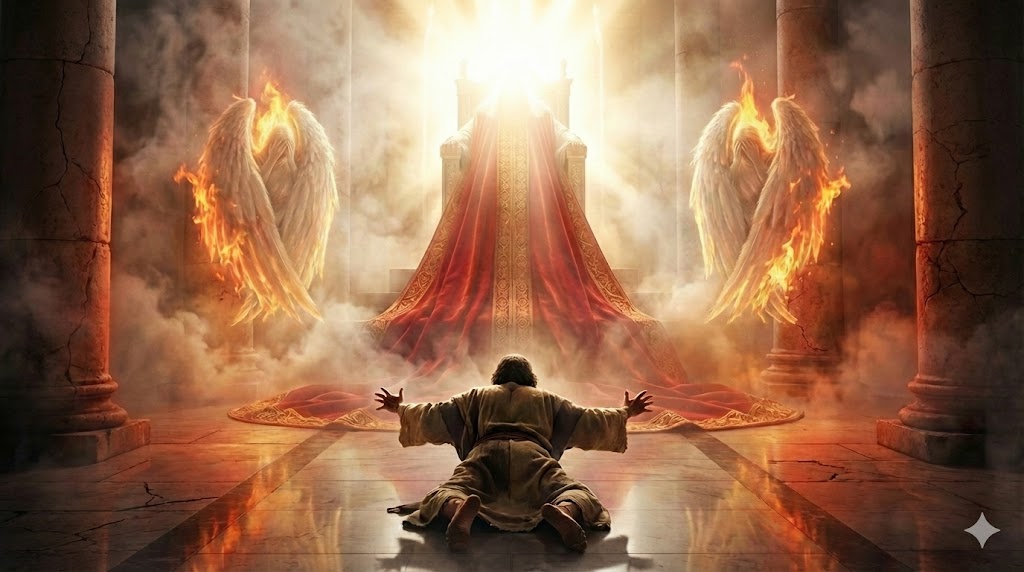
The throne was now vacant. The nation was vulnerable. And into this political and spiritual vacuum, Isaiah sees the real King—“high and exalted.” The Hebrew phrase ram v’nissa (רָם וְנִשָּׂא) appears only one other time in Isaiah’s entire prophecy: in Isaiah 52:13, describing the coming Suffering Servant: “Behold, My servant will act wisely; He will be raised and lifted up and highly exalted.” The vision is Christological from the first verse. The One seated on the throne is not an abstraction; He is a Person. John confirms it in John 12:41: “Isaiah said these things because he saw His glory and spoke of Him.” Isaiah saw the pre-incarnate Christ, enthroned in unapproachable majesty, the train of His robe filling the Temple—a deliberate echo of the cloud of glory that filled Solomon’s Temple at its dedication (1 Kings 8:10-11). The presence of God was not a doctrine to be studied. It was a reality that displaced everything else.
II. THE PROCLAMATION: THE HOLINESS WE CANNOT COMPREHEND
“Above Him stood the seraphim, each having six wings: with two wings they covered their faces, with two they covered their feet, and with two they flew. And they called to one another: ‘Holy, holy, holy is the LORD Almighty; the whole earth is full of His glory.’ At the sound of their voices the doorposts and thresholds shook, and the temple was filled with smoke” (Isaiah 6:2-4).
The seraphim are not cherubs. The Hebrew word seraphim (שְׂרָפִים) derives from the root saraph, meaning “to burn.” These beings embody flame—creatures whose very essence is fire. Their name connects them to the “fiery serpents” God sent among rebellious Israel in Numbers 21:6 as instruments of judgment. They exist in the immediate presence of the enthroned King, and yet even they cannot look directly at Him. Two wings cover their faces—not in shame, but because the unveiled radiance of God’s holiness would obliterate even these burning ones. Two wings cover their feet, a Hebrew euphemism acknowledging their creatureliness before the Creator. Beings made of fire must shield themselves from the One who dwells in “unapproachable light” (1 Timothy 6:16).
And they cry out to one another in antiphonal chorus: “Holy, holy, holy is the LORD of Hosts; the whole earth is full of His glory.”
In Hebrew, repetition signifies intensity. To repeat something twice is emphasis. To repeat it three times is to declare it absolute, superlative, the maximum possible degree. The seraphim are not saying God is “very holy.” They are proclaiming that holiness is the foundational, defining, all-encompassing essence of God’s being. The word qadosh (קָדוֹשׁ) means “set apart, separate, utterly other.” God’s holiness is not one attribute among many, as if He possesses holiness the way He possesses power or knowledge. The threefold cry and its immediate effects—the shaking doorposts, the convulsing thresholds, the temple filled with smoke—demonstrate that holiness defines all His other attributes. His love is holy love—without sentimentality, without compromise. His justice is holy justice—without corruption, without favoritism. His wrath is holy wrath—without malice, without caprice. He is not like us, only greater. He is categorically, infinitely, incomparably other.
This is why holiness feels surreal to us. We understand concepts through comparison. We know “strong” because we have experienced “weak.” We comprehend “large” because we have seen “small.” But holiness is otherness itself—God’s absolute separation from sin, from limitation, from creatureliness. We have no analogue in our experience to map it onto. We are trying to perceive what we have never been, describe what we have never touched, comprehend what lies entirely outside the boundaries of fallen existence. To encounter holiness is to collide with the category-shattering truth that there is One who is entirely unlike us, entirely beyond us, entirely other—and that this otherness is not cold distance but blazing purity.
At the sound of the seraphim’s proclamation, the doorposts and thresholds shake. The physical structure convulses. The temple fills with smoke, recalling the cloud at Sinai when God descended in fire (Exodus 19:18), the pillar that led Israel through the wilderness (Exodus 13:21), the glory that made the priests unable to stand when it filled Solomon’s Temple (1 Kings 8:10-11). This is theophany—the breaking-in of the divine into the realm of the created. And the created order cannot contain it. The very sound of God’s holiness being proclaimed causes the foundations to tremble.
III. THE EXPOSURE: THE RUIN WE CANNOT SEE WITHOUT REVELATION
“Then I said: ‘Woe is me! For I am ruined! Because I am a man of unclean lips, and I live among a people of unclean lips; and my eyes have seen the King, the LORD of Hosts’” (Isaiah 6:5).
Isaiah does not say, “I need to try harder.” He does not say, “I’ll do better next time.” He says, “I am ruined.” The Hebrew word nidmeti (נִדְמֵיתִי) carries the force of being cut off, silenced, undone, destroyed. This is not the language of mild conviction or temporary guilt. This is existential collapse. In the presence of absolute holiness, Isaiah sees himself as he truly is, and the vision obliterates every self-protective narrative he has ever constructed.
Why does he focus on his lips? Because he has just heard the seraphim proclaim God’s holiness in perfect, unceasing worship, and he realizes that his mouth—the organ of speech, the instrument of praise—has been contaminated. He cannot join the song. The chasm between the seraphim’s “Holy, holy, holy” and his own “unclean lips” is infinite. Furthermore, he is not merely confessing personal sin. He says, “I live among a people of unclean lips.” He recognizes that he is complicit in the corruption of his entire culture. He has breathed the same air, participated in the same compromises, absorbed the same lies. There is no safe distance from which to claim moral superiority.
This is the first work of holiness: exposure. God’s holiness does not merely reveal that we have done wrong things; it reveals that we are wrong—structurally, fundamentally, at the level of our being. We are sinners by nature, not merely by practice. And we cannot see this on our own. Isaiah did not perceive his uncleanness until he saw God’s holiness. The vision of God precedes the vision of self. This is why all our attempts to generate awareness of sin through introspection fail. We are using a broken instrument to measure our own brokenness. We are asking the blind to assess their own vision.
The pattern repeats throughout Scripture. Job, after thirty-seven chapters of self-justification, hears God speak from the whirlwind and says, “I had heard of You by the hearing of the ear, but now my eye sees You; therefore I despise myself, and repent in dust and ashes” (Job 42:5-6). Peter, after witnessing the miraculous catch of fish, falls at Jesus’ knees and cries, “Depart from me, for I am a sinful man, O Lord” (Luke 5:8). John, the beloved disciple who leaned on Jesus’ chest at the Last Supper, sees the risen Christ in glory and falls at His feet “as though dead” (Revelation 1:17). These men did not suddenly discover new sins. They saw themselves as they always were but could not perceive until the light exposed them.
And here is the edge: the less we sense our fallenness, the more likely it is that we have insulated ourselves from the presence of God. We prefer our own self-assessment to the verdict of Scripture. We measure ourselves horizontally—comparing our morality to our neighbor’s, our generosity to the culture’s average, our religious activity to the nominal believer’s apathy—and we come away feeling adequate. But the moment we measure vertically, against the standard of God’s holiness, the delusion shatters. Every act of self-justification, every refusal to see our need, every comparison that places us in a favorable light becomes another layer of scar tissue hardening the heart. And if we persist in this long enough, we arrive at the terrifying possibility that God will give us over to our preferred blindness, confirming our rejection by removing the very capacity to perceive our need (Romans 1:24, 26, 28). The danger is not that we will commit some spectacular sin. The danger is that we will stand in the Temple, listing our achievements, and never once cry out, “Woe is me.”
IV. THE ATONEMENT: THE COAL WE CANNOT TOUCH
“Then one of the seraphim flew to me with a live coal in his hand, which he had taken with tongs from the altar. With it he touched my mouth and said, ‘See, this has touched your lips; your guilt is taken away and your sin atoned for’” (Isaiah 6:6-7).
The Hebrew word for “live coal” is ritspah (רִצְפָּה)—a glowing, burning ember. This is not a warm pebble. This is fire drawn from the altar, the place of sacrifice, the place where the blood of atonement was applied. The seraph cannot hold it with his bare hands; he must use tongs. And he flies to Isaiah and presses it against the very place Isaiah identified as unclean—his lips. Cauterization. Surgery with flame.
And the declaration is immediate: “Your guilt is taken away, and your sin atoned for.”
Notice what the text does not say. It does not say Isaiah felt cleansed. It does not describe an emotional experience of relief. It does not record Isaiah’s subjective assessment of his spiritual state. The seraph declares the objective theological reality. The atonement is not contingent on Isaiah’s feelings; it is grounded in the sacrifice that has already been offered on the altar. The coal is not creating new righteousness in Isaiah. It is applying to him the righteousness that comes from outside himself, from the altar, from the substitute.
This is the gospel in shadow. The mechanism is double imputation—the great exchange that Paul will later articulate in 2 Corinthians 5:21: “God made Him who had no sin to be sin for us, so that in Him we might become the righteousness of God.” Our sin is credited to Christ; He becomes sin for us, though He knew no sin. Christ’s righteousness is credited to us; we become the righteousness of God in Him, though we have earned none. Isaiah deserved to be consumed by the fire of God’s holiness. Instead, the fire that had already consumed the sacrifice on the altar now purifies him. The penalty has been paid. The judgment has fallen. But it fell on the substitute.
And this drives us to the cross. In Isaiah 53:5, the same prophet who saw the Lord high and exalted will write: “But He was pierced for our transgressions, He was crushed for our iniquities; the punishment that brought us peace was on Him, and by His wounds we are healed.” The coal is the shadow. The cross is the reality. The One who was “high and lifted up” in Isaiah 6:1 is the same One who will be “lifted up” on Golgotha (John 3:14; 12:32-33). The holiness that should have destroyed us instead fell on Him. The fire that should have consumed us instead purified us because it consumed our Substitute. He did not improve us. He did not coach us toward moral betterment. He took our place. He absorbed the wrath. He satisfied the justice. And then He credited His perfect obedience to our account, so that when God looks at us, He sees not our unclean lips but the righteousness of Christ.
V. THE INVERSION: THE UPSIDE-DOWN KINGDOM
The gospel operates on a logic that inverts every assumption of the fallen world. In the kingdom of God, the greatest is the servant (Mark 10:43-44). Power is perfected in weakness (2 Corinthians 12:9). Wisdom looks like foolishness (1 Corinthians 1:25). Life is found by losing it (Matthew 10:39). And glory comes through the cross—the most shameful, degrading instrument of execution in the ancient world, declared by God to be the centerpiece of His redemptive plan. The world looks at the cross and sees defeat. God looks at the cross and sees victory, justice satisfied, love demonstrated, Satan crushed, death swallowed up. The ways of God are not merely different from the ways of the world. They are diametrically opposed.
And nowhere is this inversion more evident—or more personally threatening—than in the collision between self-righteousness and grace. Jesus tells a parable in Luke 18:9-14 to those “who trusted in themselves that they were righteous, and treated others with contempt.” Two men go to the Temple to pray. The Pharisee stands and prays, “God, I thank You that I am not like other men—extortioners, unjust, adulterers, or even like this tax collector. I fast twice a week; I give tithes of all that I get.” The tax collector, standing far off, will not even lift his eyes to heaven, but beats his breast and says, “God, be merciful to me, a sinner.” And Jesus declares, “I tell you, this man went down to his house justified, rather than the other.”
The Pharisee’s error is not in his facts, but in his posture. He probably was not an extortioner or adulterer. He probably did fast and tithe. But his entire stance is one of self-exaltation. He measures himself against other men, not against God. He lists his achievements, not his need. He compares horizontally—“I am not like this tax collector”—and congratulates himself on the favorable contrast. This is the insulation of self-righteousness. It does not look like rebellion. It looks like devotion. It does not feel like idolatry. It feels like virtue. But at its core, it is the worship of self. It is the claim that I can be the source of my own righteousness, that I can meet the standard, that I can earn God’s favor. It is the refusal to vacate the throne of the heart. And as long as we cling to this, we will never cry out, “Woe is me, for I am ruined.” We will stand in the Temple, reciting our résumés, and never once see our need for the coal from the altar.
Every time you assess your spiritual health by comparing yourself to someone you perceive as less faithful, you are making the Pharisee’s error. Every time you mentally catalog your religious activities as evidence of your acceptability before God, you are laying claim to the throne. Every time you assume that your lack of feeling sinful is evidence that you are not actually sinful, you are trusting in yourself rather than in the finished work of Christ. And each of these small rejections hardens the heart incrementally, building up scar tissue until you can no longer feel the conviction of the Spirit. You do not need to commit some spectacular act of rebellion to drift from God. You need only to prefer your own assessment over His Word, and repeat that preference until it becomes your default posture. The remedy is the gospel: Christ must increase; you must decrease (John 3:30). The throne must be vacated, and Christ must take His rightful place as Lord—not as adviser, not as helper, not as co-regent, but as absolute sovereign.
VI. THE THRONE: THE EXCLUSIVE CLAIM OF HOLINESS
“I am the LORD; that is My name! I will not yield My glory to another or My praise to idols” (Isaiah 42:8).
God does not share His throne. His holiness demands exclusive worship. This is not divine insecurity. This is ontological reality. There is one God, and we are not Him. There is one source of righteousness, and it is not us. There is one name by which we must be saved, and it is not our own (Acts 4:12). Every human heart is a throne room, and only one can occupy the throne. Jesus says in Matthew 6:24, “No one can serve two masters, for either he will hate the one and love the other, or he will be devoted to the one and despise the other.”
The question is never whether we will worship. We are worshiping creatures by design. The question is what we will worship. And whatever we ascribe ultimate worth to—whether God, or self, or comfort, or approval, or control—that is what sits on the throne of our hearts. Self-righteousness is the subtlest form of idolatry because it wears the mask of devotion. It speaks the language of faith. It performs the rituals of religion. But it refuses to let Christ alone occupy the throne. It insists on co-laboring, on contributing, on claiming some portion of the credit for our standing before God. And in doing so, it commits the very sin that destroyed Uzziah: the attempt to approach God on the basis of something within ourselves rather than on the basis of the sacrifice provided by God.
Our only standing before God is the righteousness of Christ, imputed to us by faith, received as a gift, clung to as our sole hope. We do not improve ourselves into acceptability. We are declared acceptable because Another was punished in our place and His righteousness was credited to our account. This is why the coal had to come from the altar. This is why Isaiah could not cleanse himself. This is why the seraphim covered their faces. This is why the cross is the centerpiece of everything.
VII. THE CALL: WHAT NOW?
After the cleansing, God asks, “Whom shall I send? And who will go for Us?” And Isaiah, who moments before was undone by the vision of his own ruin, responds, “Here am I. Send me” (Isaiah 6:8).
The sequence is non-negotiable. Isaiah could not respond to God’s call until he was cleansed. He could not be cleansed until he saw his ruin. He could not see his ruin until he saw God’s holiness. The entire process begins with seeing God, not with seeing ourselves. This means the path forward is not introspection but revelation. We do not generate awareness of our sinfulness by looking inward more intently. We receive it by looking upward more steadily, asking God to show us His holiness in His Word, in creation, in the person of Christ.
And the invitation is open. We are more corrupt than we ever dared believe and more loved than we ever dared hope. The same holiness that exposes our wretchedness is the holiness that provided the coal, the altar, the Substitute. God does not leave us in our ruin. He declares, “Your guilt is taken away.” Not reduced. Not managed. Not overlooked. Taken away. Atoned for. Removed as far as the east is from the west.
But we must ask ourselves: Are we regularly, intentionally exposing ourselves to the holiness of God in Scripture, or have we settled for a domesticated god who makes no demands and inspires no terror? Are we measuring ourselves vertically against His standard, or horizontally against the failures of others? Have we vacated the throne of our hearts, or are we still clutching the illusion that our contribution matters in our justification?
The seraphim still cry, “Holy, holy, holy.” The throne is still occupied. The coal is still offered. And the question still stands: “Whom shall I send?”