There is a restlessness in you that you have probably learned to ignorestrong text
It is quiet. It shows up on good days, not just hard ones — at the end of an evening that went well, in the middle of a blessing you genuinely asked God for, in a room full of people you love. Something in you stays slightly unsettled, a little unfinished, as if you are waiting for something that has not arrived. Y
ou have likely tried to fix it by getting more of what is already in front of you — a better arrangement of the same life. And the unrest stays.
Most people misread that feeling. They treat it as a problem to be solved. It is not a problem. It is a signal, and it is telling the truth.
You feel unsettled here because here is not where you belong. “Our citizenship is in heaven, from which also we eagerly wait for a Savior, the Lord Jesus Christ” (Philippians 3:20). Scripture calls you an “alien” and a “stranger” in this world (1 Peter 2:11) — not because the world is worthless, but because it is not your country. God has been wonderful to you in it. Family, friends, brothers and sisters in the Lord, worship, work, daily mercies you did not earn — these are real gifts, and you should receive them with both hands. But not one of them is your inheritance. They are provisions for the road, not the destination. “He has set eternity in their heart” (Ecclesiastes 3:11) — which means the ache you keep trying to silence was placed there on purpose. It is homesickness for a home you have not seen yet. The day you stop feeling it is not the day you have arrived; it is the day you have fallen asleep.
So the restlessness is not your enemy. It is the most honest thing in you.
Now, what do you do with a person who lives in a country that is not his own, on behalf of a King who is? Scripture has a word for that person. “We are ambassadors for Christ, as though God were making an appeal through us” (2 Corinthians 5:20).
Sit with what an ambassador actually is, because the word does real work. An ambassador lives inside a nation that is not his home. He represents a King and a kingdom that are elsewhere. He does not draw his identity, his security, or his supply from the country he lives in — all of that comes from the King who sent him. He carries an authority that is not his own; when he speaks officially, it is not his private opinion, it is his government’s word. And his whole reason for being where he is can be stated in one sentence: he is there for the purposes of the one who sent him, to represent that one faithfully, in a place he will one day leave.
That is what you are. That is why you do not feel at home — you were never supposed to. An ambassador who felt completely at home in the foreign country would be a poor ambassador; he would have forgotten who he serves. Your unrest and your assignment are the same fact seen from two sides. You are not a citizen killing time until heaven. You are a representative on active assignment, and the One you represent is the King of kings. There is no higher honor a human being can hold. The God of heaven has chosen to make His appeal through you — to let your life and your words be the way another person hears Him. That is not a burden bolted onto your faith. It is the dignity of it.
Here is where the trouble comes.
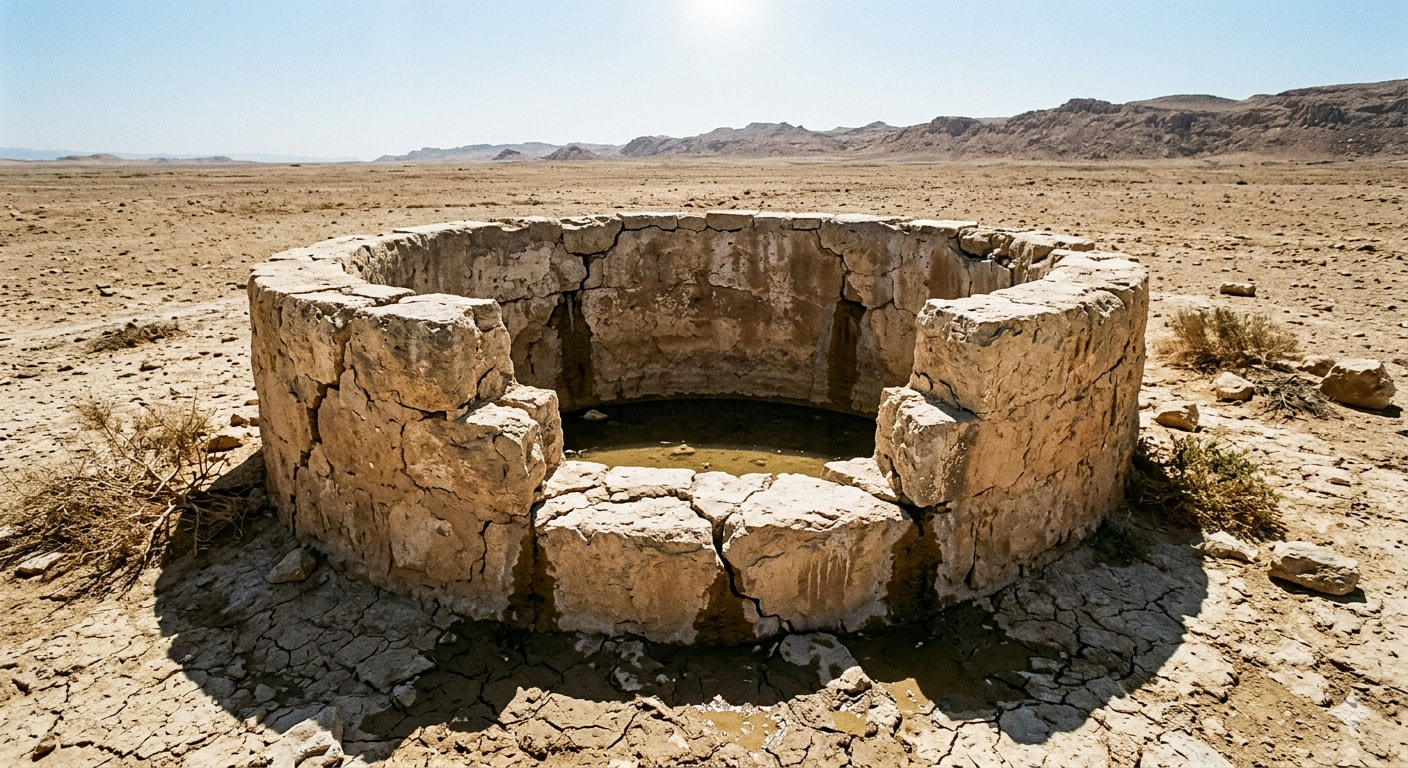
When the unrest rises and you do not know it is homesickness, you go looking for relief in the wrong place — you ask the foreign country to make you feel at home. You ask a what: what can I get, hold, achieve, or fix here that will finally settle me? But God names that exact move as the great mistake: “My people have committed two evils: they have forsaken Me, the fountain of living waters, to hew for themselves cisterns, broken cisterns that can hold no water” (Jeremiah 2:13). A cistern is something you build and keep — it holds a little water for a little while and then runs dry, and the building of it felt like devotion the whole time. The Fountain is not something you possess. He is Someone you return to, who fills you again every time you come.
That is why the struggling believer can pray and still come up empty: “You ask and do not receive, because you ask with wrong motives” (James 4:3). The failure is not in the words. It is in what the question reaches for. A what can only ever hand you a cistern. The right question was always a Whom.
And if you are the kind of person who feels the tension but cannot even name it — who could not tell anyone what is wrong or what to ask for — then hear the most important sentence in this article: that is not where help runs out. That is where it begins. “The Spirit also helps our weakness; for we do not know how to pray as we should, but the Spirit Himself intercedes for us with groanings too deep for words” (Romans 8:26). Paul includes himself in that we. Your inability to put the ache into words is not a disqualification. It is the precise condition the Spirit was given to meet. The groan you cannot translate, He is already carrying.
So where is the victory in any of this?
The victory is that you were never asked to manufacture your fullness, summon your courage, or talk yourself into feeling at home. You were asked to come to the Fountain and be filled by Another. Watch how it holds together: the ambassador speaks not because he worked up the nerve, but because “God [is] making an appeal through us” (2 Corinthians 5:20) — the Spirit doing the speaking. The thirsty seeker stops drinking from cisterns because the Father “will give the Holy Spirit to those who ask Him” (Luke 11:13) — the one gift that cannot be built or kept, because He is a Person who flows. And the one who cannot name his need is reached because the Spirit intercedes in the silence and convicts in the dark (Romans 8:26; John 16:8).
One Person, holding every joint. The victory is not that you finally became strong enough to represent the King. It is that the King put His own Spirit inside you, so that the One you represent is also the One living in you and speaking through you. “I in them and You in Me” (John 17:23). You do not carry the water. You carry the Spring.
This is what an ambassador full of his King looks like in the trenches: not someone performing the role on his good days and dropping it on his bad ones, but someone so filled at the source that what comes out under pressure is simply what is already in him. “The mouth speaks out of that which fills the heart” (Matthew 12:34). The silent, intimidated moments were never nerve failures. They were fullness failures — and the answer to an empty vessel is not more effort. It is more of the Fountain.
So do two things, and do not set this down satisfied.
Go to the text yourself this week. Read John 4 slowly and watch one woman move from a well that empties to a Spring that never does — from asking the water to asking the Man. Let it find you the way it found her.
Then go be found among people, because the most convincing thing you will ever say as an ambassador is not your explanation of the Fountain. It is that someone watches you drink — sees a stranger in this country who has stopped trying to feel at home here and keeps returning to the only source that flows — and gets thirsty enough to ask you where the water is.
That is the honor you carry. Not that you must represent the King by your own strength, but that the King chose to represent Himself through you, and then moved in to make it possible.
You were never going to feel at home here. You were never meant to. You are an ambassador — and your King is coming to bring you home.