UNION, LOVE, AND THE UNIFIED WILL IN JOHN 17
THE SILENCE BEFORE THE STORM
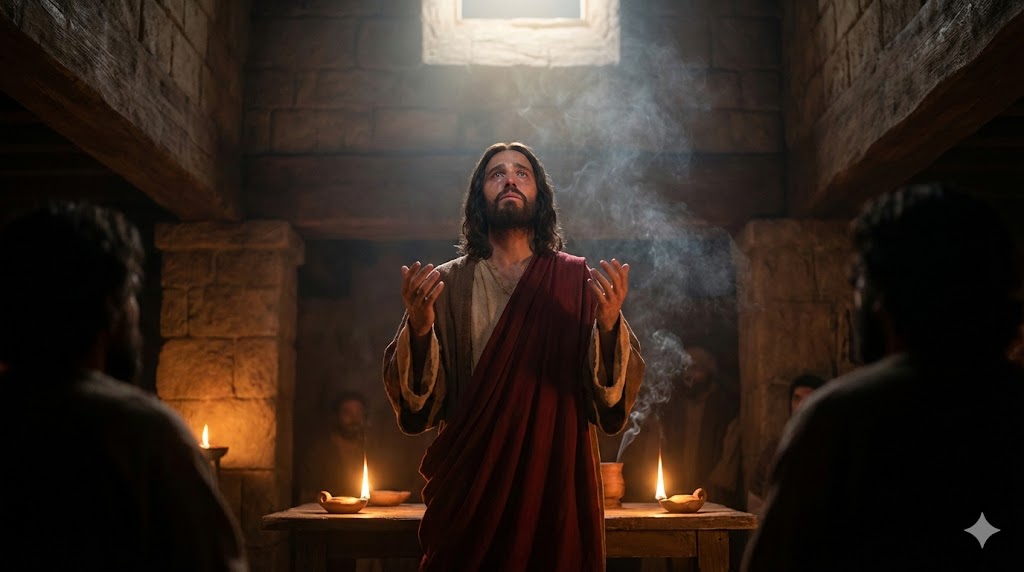
There is a specific kind of silence that falls when a man knows he is about to die. In the Upper Room, the teaching was finished. The warnings were given. In John 17, Jesus stopped speaking to men and lifted His eyes to heaven. He entered into a conversation that had been going on since before the foundation of the world, but this time, He let us listen in.
What we overhear is breathtaking. Jesus does not ask the Father to make our lives easier or to remove the struggle. He asks for something far greater—that we would be brought into the searing, holy intimacy shared between the Father and the Son. That we, wrapped in fallen flesh and prone to wander, would be held inside the very love that has existed from eternity.
THE CRISIS OF LOCATION: THE SHEPHERD IS LEAVING
The premise of the prayer is a crisis of location. The Shepherd was leaving. The physical protection of the Incarnation was withdrawing, but His people were remaining behind in a world that does not know God.
“And I am no longer in the world, but they are in the world, and I am coming to you. Holy Father, keep them in your name, which you have given me, that they may be one, even as we are one.”
(John 17:11, ESV)
For three years, Jesus had stood between His followers and the storm. He rebuked the wind. He silenced the accusers. He cast out the demons. But now, He was handing them back to the Father—not abandoning them, but transferring them into hands strong enough to hold what He had begun. As He told the Father plainly, “While I was with them, I kept them in your name, which you have given me. I have guarded them” (John 17:12). The guard was changing.
This is the moment that divides the human heart. Some hear this and feel abandoned—If Jesus leaves, who will hold me when the darkness comes? But listen closely to what He actually prays: “Holy Father, keep them in your name.” Not “keep them safe from discomfort.” Not “keep them from ever doubting or struggling.” Keep them in your name—in the very identity, character, and authority of God Himself. The Son who kept you is now placing you into the grip of the Father who cannot fail.
Others hear this and feel the full weight of love—He is not leaving me alone; He is entrusting me to the One who holds Him. The handoff is not a downgrade. It is the transfer from the visible Shepherd to the eternal Father, whose love for the Son is infinite and whose commitment to you is now bound up in the same covenant.
SANCTIFIED IN TRUTH: THE BATTLEFIELD OF THE MIND
“I do not ask that you take them out of the world, but that you keep them from the evil one. They are not of the world, just as I am not of the world. Sanctify them in the truth; your word is truth.”
(John 17:15-17, ESV)
Jesus did not pray for our escape from suffering. He prayed for our anchoring in Truth. He knew that the enemy traffics in lies—lies about our worth, lies about God’s character, lies about our future. He knew that our own hearts are compromised witnesses, agreeing with the accusations against us. So He asked the Father to sanctify us—to set us apart and hold us steady in Reality when everything around us is shaking.
The word “sanctify” means to make holy, to set apart for sacred use. But notice the instrument: “your word is truth.” Not our feelings. Not our circumstances. Not the shifting opinions of the culture or the condemning voice in our own head. The Father sanctifies us by binding us to what is objectively, eternally, unshakably true.
Picture the moment: You’ve just been betrayed by someone you trusted. Your mind is already writing the script—I should have seen this coming. I’m an idiot. I’ll never trust anyone again. The enemy doesn’t need to say a word. Your own heart is already agreeing with him. This is the battlefield. This is where sanctification happens—not in a monastery, but in the wreckage of a Tuesday afternoon when everything you believed about someone just collapsed.
And in that moment, the Father sanctifies you by binding you to what is true: You are not defined by what was done to you. You are defined by what I have spoken over you in Christ. When your mind spirals at 3am with every failure on repeat, this is the anchor: God’s Word stands. When the world tells you that you are defined by your worst moment or your greatest achievement, this is the correction: you are defined by what God has spoken over you in Christ.
A WORD FOR THE ONE WHO STRUGGLES
For the one who struggles to believe you are lovable—who looks in the mirror and sees only failure, who hears the accusing voice replaying every mistake, who wonders if you’ve finally crossed the line—hear this now, before we go any further: You are not kept by your own strength. You are not held by your ability to clean yourself up and try harder. The Father is sanctifying you in the truth—and the truth is not your performance record. The truth is what He declares over you in His Son. Your feelings about yourself do not outweigh the Father’s love for Christ. Your shame does not override the Cross. The script in your head is not the final word. God’s Word is.
THE COST OF RESCUE: WHY THE CROSS WAS NECESSARY
But this kind of rescue—this transfer from the kingdom of darkness into the kingdom of light, this transformation from rebel to beloved—comes at a cost that must not be minimized. The holiness of God cannot simply merge with the wretchedness of man without a transaction. Scripture is relentless on this point: “For all have sinned and fall short of the glory of God” (Romans 3:23), and “the wages of sin is death” (Romans 6:23). The gap between the Divine and the fallen is not a slight inconvenience to be overlooked. It is an infinite chasm. We were made to bear God’s image—“So God created man in his own image” (Genesis 1:27)—designed for intimate fellowship with our Creator, yet we consistently resist and reject the One we were made for. We crave the peace and perfection that only God can give, but we bring to the table a nature that is not only imperfect but—left to itself—hostile to the very God we seek.
This is why the Cross was necessary. Not as Plan B. Not as damage control. But as the eternal, predetermined path by which a holy God could reconcile sinful humanity to Himself without compromising His justice or His love. And this is where the prayer reveals its deepest, most staggering truth.
THE HINGE OF THE PRAYER: “I CONSECRATE MYSELF”
“And for their sake I consecrate myself, that they also may be sanctified in truth.”
(John 17:19, ESV)
Do not rush past this verse. Everything in the prayer has been building to it. Jesus has asked the Father to keep them (v. 11), to sanctify them (v. 17), to guard them from the evil one (v. 15). But now He names the cost. “For their sake I consecrate myself.” The Greek is brutal in its clarity: I am setting myself apart for slaughter. The only way the Father can keep you, sanctify you, and guard you is if the Son becomes the sacrifice. This is not Plan B. This is the plan.
When Jesus said, “I consecrate myself,” He was stepping forward as both the High Priest and the Lamb. The word “consecrate” is the same root as “sanctify”—He was setting Himself apart for sacred use. But the use was sacrifice. He was not being dragged to the Cross by an angry Father who needed someone to punish. He was walking toward it in perfect agreement with a Father who loved the world so fiercely that He was willing to do the unthinkable.
“No one takes it from me, but I lay it down of my own accord. I have authority to lay it down, and I have authority to take it up again. This charge I have received from my Father.”
(John 10:18, ESV)
Read that again. The Father gave the charge. The Son accepted it willingly. This was not divine child abuse. This was the Unified Will of the Trinity in operation. The Cross was the full, unabated wrath of God being poured out on sin—but it was executed through the mutual, eternal agreement of the Father and the Son, sharing the same divine essence, united in the same holy love. They looked at humanity—broken, rebellious, hostile—and agreed together: This is the only way. We will bear the cost. We will make the way.
The Father did not send the Son begrudgingly. The Son did not submit resentfully. They walked into the fire together so that we could be brought safely through it. The horror of the Cross—the weight of sin, the cry of dereliction, the darkness that fell—was real. But it was borne willingly, in love, by a God who does not need us but chose to remake us so that we could be with Him.
This is the measure of love we often fail to grasp. It is not sentimentality. It is not a feeling that ebbs and flows with our performance. It is the willing sacrifice of the infinite for the sake of the finite. It is the God who existed in perfect, self-sufficient joy choosing to pay an infinite price to bring you into that joy with Him.
A WORD FOR THE ONE WHO FEARS GOD IS ANGRY
For the one who has viewed God as distant, angry, or reluctantly obligated—this dismantles that lie at its foundation. The Cross was not the Father appeasing His rage on an innocent victim. It was the Father and the Son, in unified love, agreeing together to bear the cost of your redemption. The God you thought was against you became the sacrifice for you. The wrath you feared was absorbed by the One who loved you before you ever drew breath. When you imagine God as harsh, reluctant, or disappointed, you are not seeing the God of John 17. You are seeing a distortion. The real God—the one who actually exists—looked at you in your sin and said, I will go. I will pay. I will bring them home.
THE UNION: LOVED AS THE FATHER LOVES JESUS
And the result of this sacrifice is a union that defies human language.
“I in them and you in me, that they may become perfectly one, so that the world may know that you sent me and loved them even as you loved me.”
(John 17:23, ESV)
“Loved them even as you loved me.”
Let that settle. Not “loved them less, but still enough to save them.” Not “loved them conditionally, as long as they perform well.” Loved them even as—with the same quality, the same intensity, the same eternal, unbreakable affection—you loved me.
Because you are hidden “in Christ,” the Father looks at you and sees the beloved Son. He does not merely tolerate you because He has to. He treasures you. To reject you would be to reject Jesus. To abandon you would be to break covenant with His own Son. You are held not by your grip on God, but by God’s grip on you—a grip that is as strong as His love for Christ, which is to say, unbreakable.
A WORD FOR THE ONE WHO LOVES WITHOUT REGARD FOR COST
For the one who loves Jesus without regard for what you face—who says, I will serve Him forever no matter the cost—this is the reality that fuels your devotion. You are not serving a distant God hoping He will notice. You are not earning a love that must be maintained by flawless performance. You are enveloped in the love that has existed from before the foundation of the world. When suffering comes, it does not mean His love has weakened. When you falter, it does not mean His commitment has expired. You are loved as the Father loves Jesus—before you did anything to earn it, and long after you’ve done everything to disqualify yourself.
You are kept by the prayer of the Son and the grip of the Father. “I give them eternal life, and they will never perish, and no one will snatch them out of my hand. My Father, who has given them to me, is greater than all, and no one is able to snatch them out of the Father’s hand” (John 10:28-29). Your feelings about yourself do not outweigh the Father’s love for His Son. Your shame does not override the Cross. You are held.
THE DESIRE OF JESUS: THAT YOU WOULD BE WITH HIM
The prayer concludes not with a request, but with a declaration of desire.
“Father, I desire that they also, whom you have given me, may be with me where I am, to see my glory that you have given me because you loved me before the foundation of the world.”
(John 17:24, ESV)
Jesus does not just want your obedience. He wants you. He desires—the word carries longing, intention, deep personal will—that you would be with Him. Not as a servant kept at a distance, but as a beloved brought near. That you would see His glory—not from afar, but face to face. That the human experience would finally, fully be reconnected with the Divine in the way it was always meant to be.
This is not the vague wish of a benevolent deity. This is the eternal purpose of the Son of God, spoken aloud in the hours before His death. He is about to endure the Cross, and what does He want on the other side? You. With Him. Seeing Him. Brought into the radiant center of the love that has existed forever.
An earthly father may leave you exposed. The Heavenly Father holds you fast. An earthly father may die and leave you alone. Jesus died to bring you into the family and rose to ensure you made it home.
THE FINAL QUESTION
You are not kept by your willpower. You are not sustained by your ability to hold on. You are kept by the prayer of the Son and the love of the Father—the same love that has burned between them since before the stars were hung.
So tell me: If you are held by the same love the Father has for Jesus—why are you still afraid?