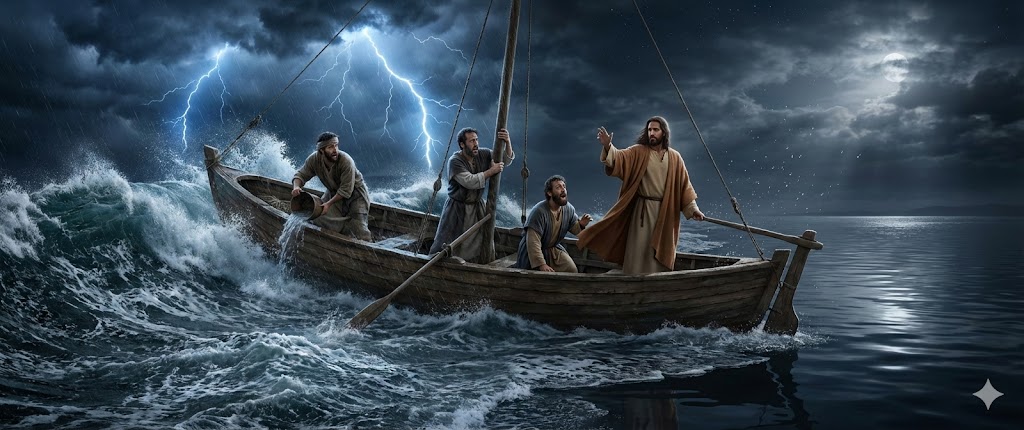
WHEN GOD CROSSED THE ABYSS
An Exposition of Matthew 8:18–34 | Mark 4:35–5:20 | Luke 8:22–39
Introduction
The account of Jesus crossing the Sea of Galilee to deliver the Gerasene demoniac is one of the most dramatic sequences in the Gospels, yet it is often fragmented in our reading. We study the calming of the storm as a “nature miracle” and the exorcism of Legion as a “power encounter,” treating them as separate events. But the Gospel writers present them as a unified narrative—a single mission in which Jesus conquers both the chaos of creation and the chaos of the soul to liberate captives who cannot free themselves.
This study examines the full arc as recorded in Matthew 8:18–34, with critical details drawn from the parallel accounts in Mark 4:35–5:20 and Luke 8:22–39. To understand the theological depth of what transpired, we must dig beneath the English translation and examine the original Greek. Words like seismos (earthquake/shaking), epitimaō (rebuke), and galēnē megalē (great calm) reveal that Jesus was not merely managing weather—He was engaging hostile spiritual forces with the authority of Yahweh Himself.
What emerges is not a detour, but a deliberate invasion: the Sovereign Lord leaving the safety of success to cross a barrier of chaos and darkness for the sake of two men the world had abandoned.
THE DEPARTURE: LEAVING SUCCESS FOR THE DARKNESS
The scene begins not with a storm, but with a departure.
It was evening in Capernaum, and Jesus was surrounded by success. Matthew 8:16 tells us “that evening they brought to him many who were oppressed by demons, and he cast out the spirits with a word and healed all who were sick.” The crowds were pressing in. The ministry was exploding. Peter’s house had become a healing center, and Jesus was at the center of it all—affirmed, celebrated, needed.
And then He gave an order that made no sense.
Matthew 8:18
“Now when Jesus saw a crowd around him, he gave orders to go over to the other side.”
This was not a casual suggestion; it was a command. “The other side” meant Gentile territory—the region of the Gadarenes. It was a place marked by tombs, pigs, and spiritual darkness. It was unclean, uncomfortable, and dangerous. Yet Jesus commanded His disciples to leave the scene of their greatest success to sail toward a shore they had no reason to visit.
Mark 4:35 preserves the timing: “On that day, when evening had come, he said to them, ‘Let us go across to the other side.’” Evening crossings on the Sea of Galilee were risky. The disciples knew this. Jesus knew this. He went anyway.
Why leave the light to sail toward the darkness?
Because on the other side of that water, there was a man—actually two men—who couldn’t ask for help, couldn’t break their own chains, and were so far gone that the world had written them off. Jesus was going to cross a storm-tossed sea to get to them.
THE BARRIER: THE SHAKING OF THE DEEP
The crossing started calmly. The professional fishermen among the disciples knew these waters. This should have been routine.
It wasn’t.
Matthew 8:24
“And behold, there arose a great storm on the sea, so that the boat was being swamped by the waves; but he was asleep.”
Matthew uses a word here that should arrest our attention. The common Greek term for a windstorm is lailaps, but Matthew chooses seismos (σεισμὸς)—the word for “shaking” or “earthquake.” This wasn’t just wind and waves; the sea itself was convulsing. Mark adds that “the waves were breaking into the boat, so that the boat was already filling” (Mark 4:37). Luke, the physician, notes with clinical precision that “they were filling with water and were in danger” (Luke 8:23).
For experienced sailors to panic on familiar waters means one thing: this storm was beyond natural. The geography of Galilee makes sudden squalls possible—winds funnel through surrounding ravines with violent force—but the term seismos suggests something deeper. The sea was not merely windy; it was shaking from below. And given the destination—a confrontation with a “Legion” of demons—the text supports the conclusion that this was more than weather. This was spiritual resistance. The realm of chaos was rising up to block the Messiah before He could reach the shore.
Yet in the middle of this death-shaking, we see the stunning mystery of the Incarnation in one image:
“But he was asleep.”
His humanity: Exhausted from ministry, the God who “neither slumbers nor sleeps” (Psalm 121:4) rests on a cushion (Mark 4:38) because His human body needs rest.
His deity: He sleeps in absolute peace because He owns the storm. He is not anxious. He is sovereign.
The disciples couldn’t hold the tension. These professional fishermen—men who had survived countless squalls—were convinced they were about to die.
Mark 4:38
“Teacher, do you not care that we are perishing?”
Their question reveals their theology. They believed the storm was more powerful than the Presence sleeping in the stern. They equated His silence with abandonment, His rest with negligence.
Jesus woke up. But before He addressed the chaos outside the boat, He addressed the chaos inside it.
Mark 4:39-40
“And he awoke and rebuked the wind and said to the sea, ‘Peace! Be still!’ And the wind ceased, and there was a great calm. He said to them, ‘Why are you so afraid? Have you still no faith?’”
Notice the sequence: Jesus rebukes the disciples while the storm is still raging. The boat is taking on water, the wind is screaming, death is imminent—and Jesus conducts a theology lesson. Why? Because the storm was not their biggest problem. Their unbelief was.
Then He stood and spoke to the wind and sea. The verb Matthew uses is epitimaō (ἐπετίμησεν)—“he rebuked.” This is not poetic language. This is a judicial term, the exact same word Jesus uses to silence demons:
- Matthew 17:18: “And Jesus rebuked the demon, and it came out of him”
- Mark 1:25: “But Jesus rebuked him [the unclean spirit], saying, ‘Be silent’”
- Luke 4:39: “And he stood over her and rebuked the fever”
You don’t rebuke inanimate objects unless you’re addressing a force with agency. Jesus treated the storm like a hostile combatant. He spoke to the wind as if it had ears, to the sea as if it had a will in opposition. And He muzzled it with a word.
The result was physically impossible.
Mark 4:39
“And there was a great calm.”
The Greek is galēnē megalē—great tranquility, mirror-like stillness. If wind stops naturally, the water stays choppy for hours as kinetic energy dissipates. The waves don’t vanish—they roll and settle gradually. But here, the seismos (great shaking) became galēnē megalē (great calm) instantly. The violence collapsed in a microsecond. The waves didn’t settle—they obeyed. The Creator spoke, and the creation snapped to attention.
Mark 4:41
“And they were filled with great fear and said to one another, ‘Who then is this, that even the wind and the sea obey him?’”
The disciples had just witnessed something that only Yahweh does. In the Old Testament, who controls the sea?
- Psalm 89:9: “You rule the raging of the sea; when its waves rise, you still them.”
- Psalm 107:29: “He made the storm be still, and the waves of the sea were hushed.”
- Nahum 1:4: “He rebukes the sea and makes it dry.”
By doing this, Jesus was claiming the prerogatives of Yahweh. The disciples were more terrified of the Man in the boat than they had been of the storm. They were beginning to realize: this is not just a teacher. This is God in flesh.
THE ARRIVAL: THE INVASION OF THE TOMBS
The boat hit the sand. The Master of the Sea stepped out to meet the master of the land.
Matthew 8:28
“And when he came to the other side, to the country of the Gadarenes, two demon-possessed men met him, coming out of the tombs, so fierce that no one could pass that way.”
Mark and Luke focus on one man—likely the spokesman or the more prominent of the two—but Matthew preserves the historical precision: there were two. This is not contradiction; it’s complementary witness. One Gospel writer zooms in on the primary figure; another captures the full count. Together, they give us the complete picture.
Mark 5 provides the horrifying close-up:
Mark 5:3-5
“He lived among the tombs. And no one could bind him anymore, not even with a chain, for he had often been bound with shackles and chains, but he wrenched the chains apart, and he broke the shackles in pieces. No one had the strength to subdue him. Night and day among the tombs and on the mountains he was always crying out and cutting himself with stones.”
Let that image settle. This man was beyond human help. The community had tried chains—he snapped them. They tried shackles—he shattered them. He lived among corpses, mutilating himself, screaming through the night. He was a walking graveyard, possessed by a force so violent that travelers rerouted to avoid the entire region. Matthew says these men were “so fierce that no one could pass that way” (8:28). They had effectively shut down the road.
The disciples, who had been shouting in the storm, now go completely silent. They fade from the narrative, likely paralyzed by fear. They’re standing in a cemetery at dusk, facing men who have terrorized an entire district.
But while the disciples were confused about Jesus’ identity (“Who then is this?”), the demons had absolute clarity.
Mark 5:6-7
“And when he saw Jesus from afar, he ran and fell down before him. And crying out with a loud voice, he said, ‘What have you to do with me, Jesus, Son of the Most High God? I adjure you by God, do not torment me.’”
This is staggering. The man ran toward Jesus—not to attack, but to fall down. The physical posture was forced submission. The chaos that had terrorized the region collapsed on its face before the Carpenter from Nazareth.
And notice the confession. The demons knew:
- His identity: “Jesus, Son of the Most High God”—the supreme sovereign over all spiritual powers
- His authority: They knew He had the right to torment them
- His timeline: They were terrified He had come to execute final judgment early
Matthew 8:29
“‘What have you to do with us, O Son of God? Have you come here to torment us before the time?’”
“The time” refers to the final judgment—the Lake of Fire described in Revelation 20:10, where “the devil who had deceived them was thrown into the lake of fire and sulfur… and they will be tormented day and night forever and ever.” The demons know their eschatology. They know their rebellion has an expiration date, and they’re begging for a stay of execution.
Mark 5:8 explains why they were screaming: “For he was saying to them, ‘Come out of the man, you unclean spirit!’” Jesus had already issued the command. The exorcism was in progress. The demons were being expelled, and they were negotiating for terms.
Then comes the chilling identification:
Mark 5:9
“And Jesus asked him, ‘What is your name?’ He replied, ‘My name is Legion, for we are many.’”
A Roman legion numbered around 6,000 soldiers. Whether literal or symbolic, the meaning is unmistakable: this man was occupied by a massive, organized, military-strength demonic force. He wasn’t just possessed—he was a fortress of hell, a garrison under enemy occupation. The term Legion itself carried weight in first-century occupied Judea. It was the symbol of Rome’s crushing military dominance. To hear that word applied to the spiritual forces inside this man was to understand: he was a war zone.
And he was completely helpless against it.
Until Jesus stepped off the boat.
THE VERDICT: THE ECONOMY OF THE KINGDOM
The demons knew they couldn’t stay. They began to negotiate.
Mark 5:10-12
“And he begged him earnestly not to send them out of the country. Now a great herd of pigs was feeding there on the hillside, and they begged him, saying, ‘Send us to the pigs; let us enter them.’”
Notice the desperation: the demons must ask permission. They can’t move an inch without His command. The terrifying “Legion” that had broken chains and terrorized a region is now reduced to begging for swine. Luke 8:31 adds another layer: “And they begged him not to command them to depart into the abyss.”
The abyss (Greek abyssos) is the holding cell for fallen spiritual forces—a place of confinement and inactivity (see Revelation 9:1–11). The demons were terrified of being thrown into the abyss immediately, which would end their ability to operate on earth. They were negotiating for a temporary reprieve, even if it meant inhabiting unclean animals.
Jesus gave one word: “Go.”
Mark 5:13
“So he gave them permission. And the unclean spirits came out and entered the pigs; and the herd, numbering about two thousand, rushed down the steep bank into the sea and drowned in the sea.”
Imagine the scene: 2,000 animals squealing in terror, stampeding down the hillside, crashing into the water, drowning in the chaos. The Greek word for “rushed” is hōrmēsen—a violent, uncontrollable charge. The ground would have shaken. The sound would have been deafening. And then, silence—just the churning foam and floating carcasses.
The destructive nature of evil was laid bare. The demons didn’t want the pigs to die—they wanted bodies to inhabit. But their very nature is so toxic that they immediately destroy whatever they touch. The human spirit, made in the image of God, is resilient enough to sustain demonic oppression for years (though it ruins the life). An animal has no such capacity. The moment high-voltage evil entered the pigs, their instincts short-circuited into immediate self-destruction.
And notice the irony: the demons begged to avoid the abyss, but they drove the pigs into the sea—the very symbol of the abyss in Jewish thought. In their frenzy to escape judgment, they enacted a picture of their own drowning. Evil always eats itself.
But here’s the question that cuts to the heart: Why did Jesus allow this?
Because He valued two human souls more than 2,000 pigs. He was willing to bankrupt the local economy to ransom the captives. This reveals the stunning value system of the Kingdom: people over profit. Souls over security. A herd worth a fortune was sacrificed for two men the world had written off.
The herdsmen fled to the city. The townspeople came out. And what did they find?
Mark 5:15
“And they came to Jesus and saw the demon-possessed man, the one who had had the legion, sitting there, clothed and in his right mind, and they were afraid.”
Clothed. Sitting. In his right mind.
The man who had been shrieking, bleeding, chain-breaking terror was now calm, coherent, restored. Luke 8:35 adds that he was “sitting at the feet of Jesus.” The posture of a disciple. The posture of worship. That’s what proximity to Jesus does. That’s what His authority accomplishes.
But here’s the tragedy:
Mark 5:17
“And they began to beg Jesus to depart from their region.”
Matthew 8:34 expands: “And behold, all the city came out to meet Jesus, and when they saw him, they begged him to leave their region.”
They saw the miracle. They saw the man delivered. They saw the evidence of divine power. And they wanted Jesus gone. Why? They cared more about their pigs than the man. They cared more about their economy than their Messiah. The presence of holiness confronted them, and they chose comfort over Christ.
THE COMMISSION: FROM TERROR TO TESTIMONY
The delivered man had a different response.
Mark 5:18
“As he was getting into the boat, the man who had been possessed with demons begged him that he might be with him.”
This man wanted to follow Jesus. He wanted to get in the boat and leave everything behind. And Jesus said no—but this refusal is pure love:
Mark 5:19-20
“But Jesus said to him, ‘Go home to your friends and tell them how much the Lord has done for you, and how he has had mercy on you.’ And he went away and began to proclaim in the Decapolis how much Jesus had done for him, and everyone marveled.”
Jesus commissioned him as the first missionary to the Gentile Decapolis. The man who had been a terror became a testimony. The man who had driven people away now drew them in. And everyone who heard him marveled.
Jesus got back in the boat and left (Matthew 9:1). He crossed the storm, fought the Legion, destroyed the economy, endured the rejection of the city—all for two men. He spent His power and authority on someone the world had written off. And then He left the man as a witness in the very place that rejected Him.
REFLECTION AND APPLICATION: THE INVASION OF YOUR CHAOS
Step back and see the whole arc:
- Jesus left the crowds who were seeking Him
- He crossed a violent storm at night into hostile territory
- He conquered the chaos of the sea with a word
- He confronted a Legion of demons in a graveyard
- He destroyed a fortune in livestock
- He faced the rejection of an entire region
And He did it all for two men who couldn’t ask for help.
This is not generic compassion. This is relentless, costly, particular love. Jesus didn’t send someone—He went Himself. He didn’t avoid the storm—He rebuked it. He didn’t calculate the economic cost—He prioritized the souls.
Now bring this home.
You, sitting in your chains—whether they’re addiction, shame, depression, fear, or the specific torment you know by name—you are worth the storm to Jesus. You are worth the crossing. You are worth the cost. The same authority that shattered Legion’s hold and calmed the sea speaks to your bondage: “Come out.”
And here’s what you need to know: the man didn’t clean himself up first. He didn’t break his own chains. He didn’t make himself presentable. Jesus came to him in the tombs, in the blood, in the chaos. That’s where Jesus does His work. Not after you’ve gotten better. Not when you’ve proven you’re worth it.
Now. In the mess.
The town rejected Jesus, but the man received Him—and that man’s life became a testimony that “everyone marveled” at (Mark 5:20). When Jesus delivers, the evidence is undeniable. Clothed. Sitting. In his right mind. Proclaiming what the Lord has done.
That’s the pattern. That’s the promise.
If Jesus risked a storm, crossed into enemy territory, and bankrupted a region for a man the world called hopeless—and that man is you—what are you still protecting that’s keeping you in the tombs?