Exposition of Luke 2:8-12
This is the Christmas story. The one you know. Luke’s account of the night Jesus was born—shepherds in a field, angels appearing, the announcement of the Savior’s birth. It’s been read every December for two thousand years, in every church, in every language. You’ve heard it before.
But what if, beneath the familiarity, there’s something we’ve overlooked? Not a hidden meaning or a secret message—the text is clear. But perhaps the weight of what’s being announced has been dulled by repetition, flattened by cultural sentimentality into something safe and beautiful. The culture has given us Santa Claus but not Christ, toys but not worship, a cute baby in a manger without the message or the meaning of why that was necessary. We’ve been handed a domesticated version of an event that should make us tremble.
This study is an invitation to read it again—to step back into that field outside Bethlehem and encounter the event as Scripture presents it. We’re going to move slowly through Luke’s account, and we’re going to focus intently on three specific titles the angel announces about this child: Savior, Messiah, and Lord. Not as a mere list of names, but as the divine explanation for how the unapproachable God, whose glory is a consuming fire, crossed the abyss to save His people.
Let’s begin where Luke begins.
The Field
“And in the same region there were shepherds out in the field, keeping watch over their flock by night.”
— Luke 2:8
The night over Bethlehem was cold and familiar. On the hillsides outside the city, shepherds were keeping watch over their flocks—work that was necessary but unimpressive. Society considered them common, insignificant, yet God chose them to bear witness. He has always worked this way, “choosing what is low and despised in the world” to shame the proud (1 Corinthians 1:27–28).
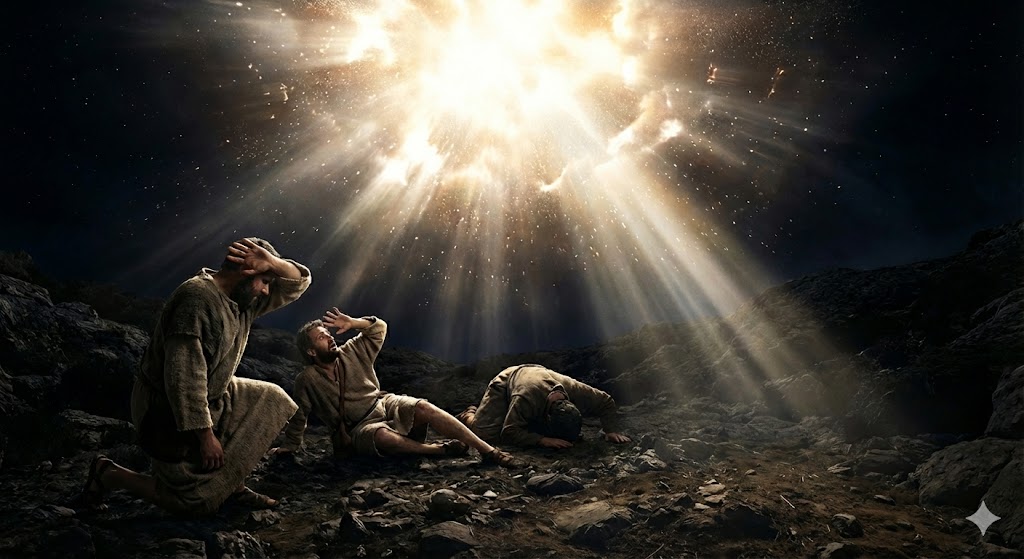
The shepherds were not waiting for a sign. They were waiting for morning.
But God tore a hole in their reality.
The Glory
“And an angel of the Lord appeared to them, and the glory of the Lord shone around them, and they were filled with great fear.”
— Luke 2:9
Do not let familiarity dull this. Do not read “glory” as a gentle glow, a halo of soft light suitable for a Christmas card.
This was the doxa—the Greek word the Bible uses to translate the Hebrew kavod, the manifest presence of YHWH Himself. YHWH—the personal, covenant name of God Almighty, the name so sacred that faithful Jews would not speak it aloud, the name that means “I AM WHO I AM” (Exodus 3:14)—the self-existent, eternal, all-powerful Creator of heaven and earth. This was not an angel’s light. This was the glory of God Himself made visible.
This was the same glory that filled the temple so completely that the priests could not stand to minister (1 Kings 8:10–11). This was the same presence that made the prophet Isaiah—a man called by God, a righteous man by any human measure—cry out not in worship but in terror when he saw the Lord seated on His throne:
“Woe is me! For I am lost; for I am a man of unclean lips, and I dwell in the midst of a people of unclean lips; for my eyes have seen the King, the LORD of hosts!”
— Isaiah 6:5
Isaiah’s response reveals the truth: even the righteous cannot stand before infinite holiness. To see God is to see your own ruin. The prophet did not see his sin clearly until he saw God’s glory fully. That is what holiness does—it exposes everything.
The Terror
Stand on that hillside for a moment. Picture the darkness—the cold, the silence, the ordinariness of night watch. Then, without warning, light that isn’t light erupts around you. It is presence. It presses against you, fills the air, makes your knees weak and your breath catch.
The text tells us plainly: “they were filled with great fear” (Luke 2:9).
This was not surprise. This was not wonder. This was the sane and sacred terror of a creature suddenly standing in the presence of the Creator. It was the reflexive knowledge that holiness and sin cannot coexist—that the equation written into reality itself is this:
Sinful Humanity + Holy God = Death
The shepherds knew it instinctively. Isaiah knew it by revelation. And if we are honest—if we strip away the religious performance and the carefully curated self-image—we know it too. We feel it in the 3am moments when sleep won’t come and the ceiling becomes a screen replaying what we’ve done. The lie told to protect reputation. The person betrayed for advantage. The lust fed in secret. The bitterness nursed into hatred. In those moments, the question rises unbidden: What happens when I stand before the God who sees it all?
The shepherds were living that question in real time.
The Word That Stands Between
The shepherds stood in terror, exposed before the holiness of YHWH. They were unclean. They were unworthy. By every measure of justice, they should have been consumed.
But the response to their terror was not judgment. It was love.
“And the angel said to them, ‘Fear not, for behold, I bring you good news of great joy that will be for all the people. For unto you is born this day in the city of David a Savior, who is Christ the Lord.’”
— Luke 2:10–11
These shepherds—common, insignificant by the world’s measure, undone by the presence of God—were chosen to receive the announcement of the Savior. Not because they were worthy, but because God is merciful. The glory that should have destroyed them became the light that revealed their rescue.
Here it is. The announcement. The three titles compressed into a single sentence. Read them again slowly: a Savior, who is Christ the Lord.
These are not decorative titles. They are not religious formalities added to make the moment sound more sacred. They form the architecture of our rescue, and each one answers a specific dimension of the terror the shepherds were experiencing. Each title is revelation—revealing His mission, His authority, and His very identity.
Let’s unpack them one at a time.
First Title: The Savior — The Mission
“For unto you is born this day in the city of David a Savior…”
The Greek word is Sōtēr—a Rescuer, a Deliverer. In that field, standing in the unbearable presence of God’s glory, the shepherds understood this title with perfect clarity. They needed rescue from the immediate peril of that holiness. The glory that surrounded them was not safe. It was the presence of the God who is “a consuming fire” (Hebrews 12:29), and they were standing in it, unprotected.
But the angel’s message reached beyond that moment. For us now, two thousand years later, the title “Savior” means rescue from the ultimate peril that glory represents. It means deliverance from “the wrath of God” (Romans 5:9), from “his righteous judgment” (Romans 2:5), from the final reckoning when every hidden thing will be brought to light and every soul will give account.
The mission is rescue—not improvement, not moral coaching, not religious sentiment. Rescue from the wrath that was coming, the judgment that was certain, the death that was deserved. He came to stand between us and the consuming fire.
This is not about admiring a beautiful story or celebrating a cultural holiday. This is about whether you believe you actually need rescue—or whether you’ve spent years constructing a version of God comfortable enough that you no longer tremble, a mental list of people worse than you to make yourself feel acceptable.
Second Title: The Messiah — The Authority
“…who is Christ…”
Christos—the Anointed One, the Messiah. For shepherds steeped in the hope of Israel, this word carried the weight of centuries. This was the promised King from David’s line, the one who would come to restore all things, to fulfill every covenant, to make right what sin had broken.
But here is what we understand now that the shepherds could not yet see: this Messiah did not come to conquer through earthly power. His authority was established through a different path—the path of suffering. Isaiah had prophesied it:
“But he was pierced for our transgressions; he was crushed for our iniquities; upon him was the chastisement that brought us peace, and with his wounds we are healed.”
— Isaiah 53:5
His kingdom is not entered by the sword. It is entered by the cross. His authority is not seized—it is earned. Not through the sword that takes life, but through the cross that gives it. His kingdom is established in blood, but it is His own.
This Messiah does not ask for your religious activity or your family tradition. His finished work—His obedience, His sacrifice, His resurrection—is the only thing that stands between you and the wrath you deserve. And that work demands a response: not admiration from a safe distance, but repentance and faith, surrender and worship.
Third Title: The Lord — The Identity
“…the Lord.”
Here is where the divine logic shatters everything. The angel has just declared this child is Kyrios—the word the Greek Old Testament uses for the unpronounceable name of God, YHWH. This is not a title of respect. This is not “sir” or “master.” This is the declaration of full divinity.
The baby in Bethlehem is God Himself.
The glory blazing around the shepherds—the presence that terrified them, the holiness they could not survive—belongs to this child. He is not a messenger from God. He is not empowered by God. He is God, “the radiance of the glory of God and the exact imprint of his nature” (Hebrews 1:3).
And the sign given to prove this staggering claim?
“And this will be a sign for you: you will find a baby wrapped in swaddling cloths and lying in a manger.”
— Luke 2:12
The Sign
Stop here. Let the collision land.
The shepherds have just been blasted with the glory of YHWH—the name so holy Israel would not speak it aloud, the presence so overwhelming that to see it meant death. And the angel says, “Here is your sign: Go find a baby. Wrapped in strips of cloth. Lying in a feeding trough for animals.”
Not a throne. Not armies. Not a palace or even a proper bed.
A manger.
Picture it. The glory that could obliterate a nation with a word has become an infant small enough to cradle in two hands. The One before whom seraphim cover their faces in terror (Isaiah 6:2) is lying uncovered in a feeding trough. The King of the universe is wrapped in borrowed cloth, dependent on a carpenter’s protection and a virgin’s milk. The voice that spoke galaxies into existence is now the cry of a newborn who cannot yet form words. The hands that hold all things together (Hebrews 1:3) are tiny fists that cannot yet grasp.
This is the kenosis, the profound self-emptying that the apostle Paul would later try to capture:
“[Christ Jesus], though he was in the form of God, did not count equality with God a thing to be grasped, but emptied himself, by taking the form of a servant, being born in the likeness of men. And being found in human form, he humbled himself by becoming obedient to the point of death, even death on a cross.”
— Philippians 2:6–8
Why would the Lord of Glory do this?
Because these are not mere titles—they are the revelation of His mission, His authority, and His very identity. He became our Savior by becoming vulnerable to death, stepping into the line of fire so that the wrath we deserved fell on Him. He became our Messiah not through conquest but through sacrifice, establishing His authority by laying down His life. He revealed Himself as Lord not by remaining in unapproachable glory, but by emptying Himself and stepping into our skin, our weakness, our humanity—so that He could bridge the abyss between sinful humanity and holy God.
The manger is not a contradiction of His divinity. It is the proof of His love.
The story is seamless. The mission (Savior) required the sacrifice (Messiah) made possible by the identity (Lord). Every piece fits together, and it all points to one truth.
The Conclusion
The terror of the field and the tenderness of the manger both point to the same stunning reality, spoken by the Lord Himself:
“For God so loved the world, that he gave his only Son, that whoever believes in him should not perish but have eternal life.”
— John 3:16
This is the invitation. Not to admire a beautiful story. Not to celebrate a cultural holiday. Not to feel warm sentiments about peace and goodwill.
The invitation is to believe—to trust that this Savior, this Messiah, this Lord has done what we could never do. That He crossed the abyss. That He stood in the gap. That He absorbed the wrath. That He made a way.
The domesticated Christmas offers comfort without cost, beauty without terror, a baby without a mission. It asks nothing of us. It gives us a Jesus who fits neatly into our lives without ever disrupting them, who affirms our choices without ever confronting our sin, who rescues us from discomfort but never from ourselves.
The biblical Christmas reveals a holy God whose glory should destroy us, and then shows us the manger where that same God made Himself small enough to save us. It confronts us with the weight of our sin and the wonder of His love. It presents us with a Savior who is sufficient for our rescue, a Messiah who is victorious over our enemies, and a Lord who is worthy of our worship.
The story has been told. The titles have been revealed. The invitation has been extended.
What will you do with this Savior, this Messiah, this Lord?